A technical partner
for your startup.

Build your first product or your next release, with security and deployment in the scope. We help technical and nontechnical founders from bootstrapped and pre-seed teams to Series A startups.

Discuss your startup

You know the problem.
We help build the product.

You do not need a technical background or a finished specification to start a conversation.

Meld Origins is a technical implementation partner for startups. We help small teams and founders scope, build and launch software products, including minimum viable products (MVPs), SaaS applications, AI features and the backend systems behind them. Sourish Sarmah leads the technical work and communication directly from Guwahati, India, working remotely with teams globally.

For nontechnical founders

Bring the customer problem, how you solve it today and what your first users need to do. We turn that into a clear user journey and build scope. We explain decisions about technology, cost and operating requirements in plain language, with working demos you can review.

For technical founders and existing teams

Bring the codebase, architecture and delivery priorities. We can own an agreed implementation milestone or work alongside your developers on a product flow, integration, AI capability or backend system.

Product experience
at the funding stage.

Sourish Sarmah’s prior role, bringing experience into Meld Origins.

During Agentic Private Markets’ funding stage, Sourish helped build its AI product and implement security controls supporting SOC 2 readiness. That experience informs how we approach a startup product: implementation, security and the services needed to run it.

Building the AI product

His work included multi-agent research, realtime voice and enterprise Text-to-SQL capabilities. These connect the product experience to the data, integrations and backend behavior that make it usable.

Security implementation and SOC 2 readiness

Sourish contributed to the product’s security implementation and SOC 2 readiness work. Identity, access permissions and safe data access also feature in his enterprise Text-to-SQL work. Read the engineering note on identity and query guardrails; Agentic Private Markets describes its current security status in its Trust Center.

Engineering for growing demand

His backend work included concurrent AI research and recovery after failed generated queries. The same attention to capacity, bounded work and recovery informs how we deploy services and plan for more users and traffic. Explore the notes on responsive AI research and database recovery.

Start where
your startup is.

The product, budget and current team shape the engagement. Funding stage gives context for that conversation.

Bootstrapped and small teams

Choose a focused first workflow and a manageable build scope. Decide what needs custom software, what an existing tool can cover, and what can wait until you have user feedback.

Pre-seed: build a first usable MVP

Define the smallest useful release around a real customer task. Map the core screens, data and integrations, then build something early users can try. Keep assumptions, exclusions and the next milestone explicit.

Seed: develop the product you have

Turn feedback into the next release. Extend the existing application, add integrations or AI capabilities, and address the release checks, visibility and recovery the product needs.

Series A: add engineering capacity

Work with your technical lead and product team on a defined part of the roadmap. Scope new product capabilities, backend changes, AI implementation or reliability work around the existing architecture and team responsibilities.

End to end,
from product to production.

We handle the agreed technical product scope: build the application, implement security and deploy services with a plan for growth.

For example, a founder building a customer portal might start with account access, one request workflow and a status view. Billing automation, advanced analytics and additional roles can be considered separately. The right MVP depends on what your users need to accomplish, rather than a standard feature bundle.

Product flows and implementation

Agree the essential screens, application behavior, APIs, data model, authentication and integrations. Define what completion looks like for each milestone. See the broader software product development service for implementation scope.

AI where it serves the workflow

If the product needs AI, define the task, knowledge sources, tool access and evaluation cases. Build permissions and failure handling alongside the feature. Explore AI agent development and workflow automation.

Security built into the product

Scope authentication, role-based access, data permissions, secrets management and audit logging alongside the application. When SOC 2 is a business requirement, agree the technical controls and readiness work with the people responsible for the audit. Sourish brings SOC 2 readiness experience from his prior work at Agentic Private Markets.

Deployment and services that can grow

Deploy the application and backend with monitoring, backups, release controls and a recovery plan. Design the service boundaries, database access and background jobs around the expected workload. As users and traffic increase, use measurements and load testing to identify bottlenecks and adjust capacity. Explore backend engineering and deployment and DevOps.

Ownership and a usable handover

Agree source-code ownership, repository and deployment account access, operating documentation and support responsibilities. Walk through how the product is deployed, monitored and maintained so your team can run it and plan the next release.

A clear way
to work together.

  1. Bring the idea and constraints

    Tell us who the product is for, the main task it should solve, what exists today, and your budget and target date. A rough outline is enough for the first conversation.

  2. Agree a milestone and review the build

    Define the deliverables, exclusions, technical decisions and review points. Review working increments together and make scope changes explicit. Nontechnical founders can evaluate the product through its actual user flows.

  3. Launch, hand over and decide what comes next

    Complete the agreed release checks and documentation. Walk through the product and operating controls, then agree any further work using the feedback and priorities you have.

Inspect what
we build ourselves.

Our own products give you a concrete starting point for evaluating the work.

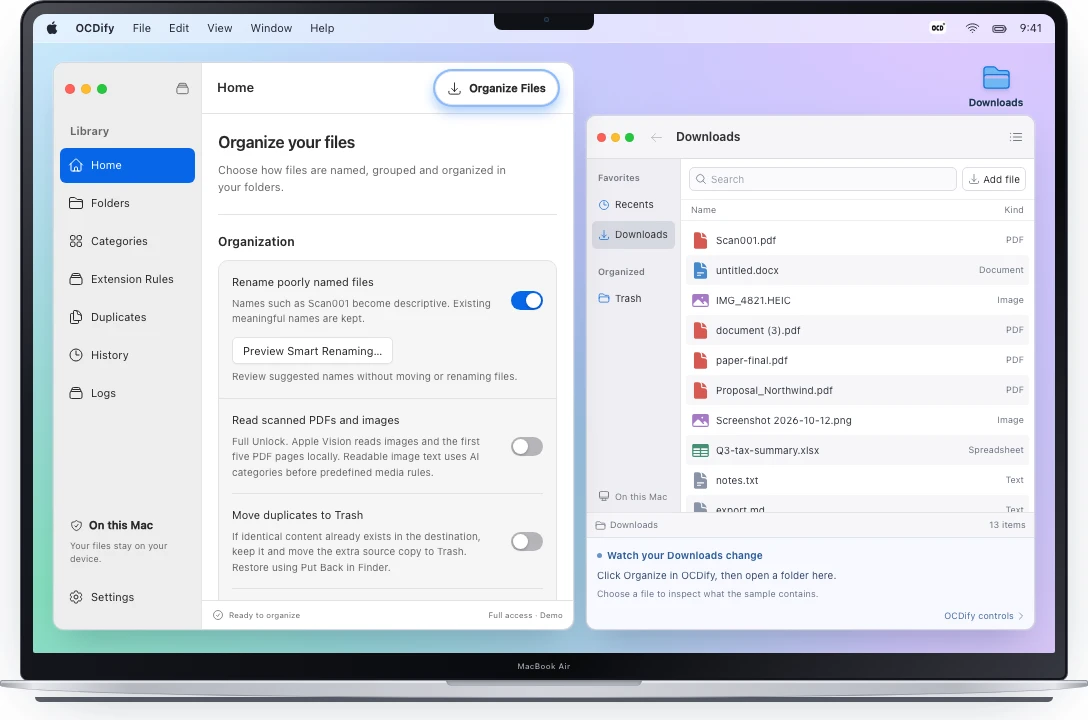
OCDify is a studio-owned macOS app that organizes files with local AI, folder controls and undo history. The OCDify case study explains its public product behavior and engineering boundaries.

OCDify app preview alongside Finder with fictional sample documents
Public OCDify product preview with fictional sample files.

Also explore Supaintro, an AI video production product, and Outstation, an AI travel planning product.

These are studio-owned products. The Agentic Private Markets work above comes from Sourish’s prior role; explore his broader company experience.

Questions founders
ask before a build.

Can a nontechnical founder build a startup product with Meld Origins?

Yes. Meld Origins works with founders who do not code. You bring the customer problem, business context and feedback; Sourish translates that into a technical scope, explains the tradeoffs and leads the agreed implementation. You review working software throughout the build.

Do you work with bootstrapped and pre-seed startups?

Yes. We can help a small or bootstrapped team scope its first product, and work with pre-seed founders on an MVP. Share your budget constraints, users and the core workflow. We agree a useful first milestone and what can wait, rather than assuming a large initial build.

Can you help a seed or Series A startup with an existing product?

Yes. The engagement can cover a new feature, an AI integration, backend engineering or gaps between a prototype and a production release. We review the current code, team and operating requirements before agreeing responsibilities.

What is included in MVP development?

The scope can include the user flows, application interface, APIs, data model, authentication, integrations, security controls, testing and deployment needed for the agreed first release. We specify deliverables, exclusions, review points and handover before implementation. Any specialist design or engineering involvement is discussed with you.

Can you build on a prototype made with AI or no-code tools?

We can review an existing prototype and identify what to keep, change or rebuild. The review looks at code access, user accounts, data storage, integrations, deployment and maintainability. It establishes the next engineering milestone before committing to a rewrite.

How much does startup MVP development cost, and how long does it take?

Cost and timing depend on the core workflow, integrations, existing code, data access and release requirements. Share your available budget and target date. We estimate a defined scope with review points; this page does not promise a fixed price or universal launch timeline.

Do I need a technical cofounder before hiring an implementation partner?

You can work with an external implementation partner before hiring an internal technical team. You still need someone on your side to make product and business decisions and provide feedback. We agree who makes technical decisions during the engagement and how the product will be handed over to your team.

Who owns the code, accounts and product after the build?

We agree source-code ownership, third-party licenses, repository access, deployment accounts and documentation in the scope and contract. We plan the handover so you know what your team receives. Further development, maintenance and support are agreed separately.

CONTACT

Tell us about your startup.

Tell us who the product is for, what exists today, and your budget and target date. A rough outline is enough to start.

Let’s make it real.

Share a brief outline. Sourish will reply directly to discuss scope, feasibility, and a sensible first milestone.

support@meldorigins.com ↗

Project meetings and delivery communication are in English.

To: Meld OriginsProject enquiry ↗

Opens your email app with these details. You can also write to us directly.