A first usable release
Turn a product idea into an agreed first milestone: the user journey, essential features, data, integrations and acceptance criteria. Decide what belongs in the first release and what can wait.
A development partner for founders and product teams building a first release or extending an existing product. We connect product scope, software implementation, AI features and deployment, with Sourish leading the technical work.
Discuss your productBring an outline, an existing codebase or a workflow that needs to work better.
Turn a product idea into an agreed first milestone: the user journey, essential features, data, integrations and acceptance criteria. Decide what belongs in the first release and what can wait.
Connect an agent, retrieval workflow or data tool to your existing application. Define the API boundary, permissions and failure handling alongside the user experience.
Review the current build, then scope the gaps in authentication, data handling, background jobs, evaluations, deployment and monitoring. Preserve useful work and make the next release operable.
A product needs a usable interface and dependable services behind it. We agree the required application work, integrations and responsibilities before implementation, including any specialist design or engineering involvement.
Build the agreed product flows, APIs, data models, authentication and integrations. Python, FastAPI, Postgres and Redis are common tools in our backend work; the existing product and team inform the stack.
Connect knowledge and approved tools to the task. Use representative evaluation cases, bounded actions and human review where decisions have consequences. Explore AI agent development and workflow automation.
Plan environments, secrets, background work, monitoring and recovery with the people who will run the system. See our deployment and DevOps work.
Review the users, current system, constraints, data access and target date. Agree deliverables, exclusions, responsibilities and the evidence that will show the milestone is complete.
Use working software to test assumptions. Review progress and acceptance criteria together, and make changes to scope explicit rather than letting them accumulate unnoticed.
Work through the agreed release checks, deployment notes, known limitations and operating documentation. Agree the source-code and account handover and any support after launch.
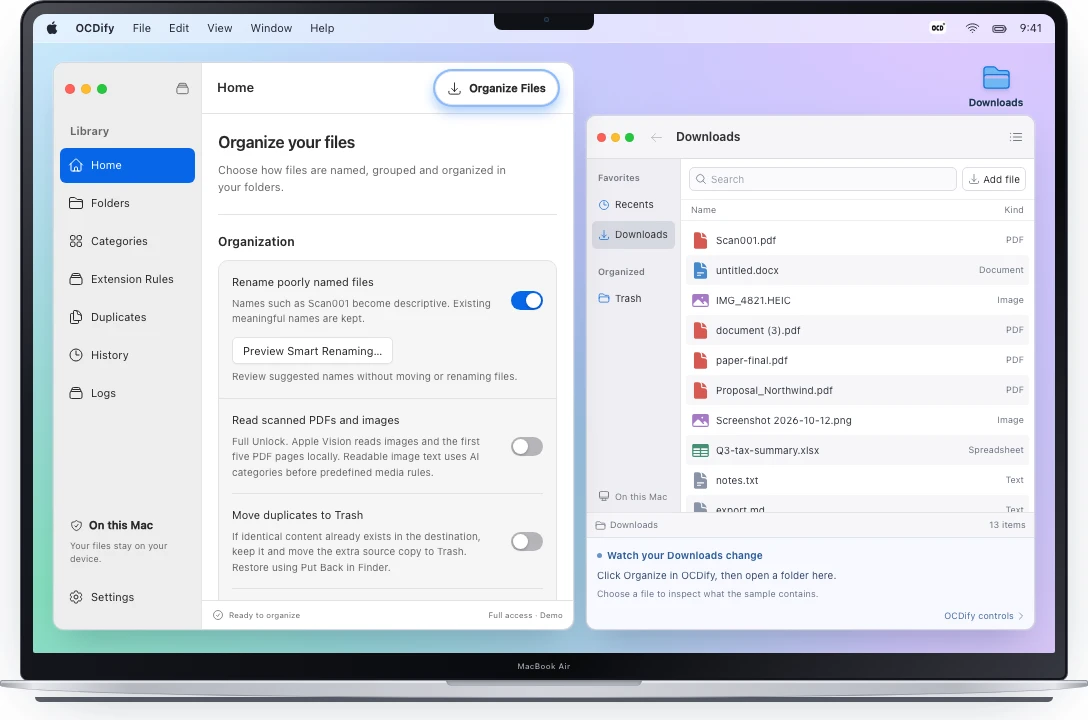
OCDify is a Meld Origins Mac app that uses local AI to organize files. Its public product experience makes privacy boundaries, folder permissions and recovery visible to the person using it.
Read the OCDify product case studyStudio-owned product work. Prior employment experience is described separately on the founder experience section.
We estimate after understanding the work. There is no universal package price or delivery date.
Useful when the idea or prototype needs a clearer implementation plan. Start with the main workflow, constraints and the decisions blocking delivery.
Useful when a first release, integration or AI capability has a clear objective. Agree what is included, how it will be reviewed and what the handover covers.
Discuss subsequent releases, reliability work or ongoing improvements after the first milestone. Availability, responsibility and support terms are agreed for the specific engagement.
We can scope product implementation alongside the backend, AI features and deployment. The proposal makes the application work, specialist involvement and responsibilities explicit. A focused first release is usually the clearest place to begin.
Yes. We review the current architecture, integrations, deployment setup and team responsibilities before proposing changes. The scope can cover a particular feature or a wider product milestone.
Sourish leads the technical work and client communication. Any additional specialists are discussed as part of the scope; the engagement does not assume a large delivery team.
The estimate depends on the product flows, integrations, existing code, security requirements and release checks. Share your target date and budget constraints so we can discuss a realistic first milestone.
We agree source-code ownership, third-party licenses, deployment accounts, documentation and handover in the scope and contract. Any ongoing maintenance or support is agreed separately; it is not implied by the initial build.
CONTACT
A useful first conversation starts with the workflow, constraints, and what success would look like.
Share a brief outline. Sourish will reply directly to discuss scope, feasibility, and a sensible first milestone.
support@vyanlabs.in ↗